

Operative endoscopy
Minimally invasive surgical procedures are performed in the department:
Endoscopic polypectomy
Procedure for removal of polyps (benign epithelial tumors) of the upper and lower gastrointestinal tract. It is performed using special endoscopic "smart"-electric knives, forceps, loops, needles. Despite the fact that this manipulation refers to minimally invasive surgical procedures, it is performed on an outpatient basis in the EMC. At the end of the procedure, the patient is taken to the ward to wake up, where he stays for about an hour, after which he can leave the clinic on his own. After removal of the polyps, a follow-up endoscopy is recommended once a year (depending on the histological examination of the removed polyp). In the EMC Endoscopy Department, non-epithelial submucosal tumors and early cancers of the stomach and colon are removed by mucosal resection and submucosal dissection (EMR, ESD).
Operations are performed through an endoscope, "without skin incision". The duration of hospitalization is 3-4 days.
Endoscopic ligation of varicose veins of the esophagus
This is an endoscopic method of treatment and prevention of bleeding from the veins of the esophagus, in which varicose veins of the esophagus are ligated using small elastic
rings.
Endoscopic probing of the small intestine
For certain diseases of the upper gastrointestinal tract, in patients in severe and extremely serious condition, it is necessary to install a special probe for enteral nutrition in the small intestine.
Endoscopic augmentation of the esophagus
Augmentation of the esophagus is performed with its narrowing of cicatricial and, less often, tumor origin. In the case of cicatricial stenosis of the esophagus as a result of chemical burns and peptic esophagitis, augmentation is the main treatment method. There is a distinction between early (preventive) bougie (in the acute stage of a chemical burn) and later (with stricture formed). The most acceptable method is to augment the esophageal strictures with hollow X-ray contrast boughs along a metal conductor string.
Balloon dilation
This endoscopic manipulation is performed for strictures of the esophagus, colon, and small intestine. The advantage of balloon dilation is the uniform effect of pressure throughout the stenosis. At the same time, a special balloon is installed in the narrowing area, which is inflated with water.
Installation of an intragastric balloon for weight loss
This technique is based on the installation of a special balloon in the stomach, into which water (about 600 ml), colored with a safe dye, is instilled. The balloon stays in the stomach for 6 months, fills most of the stomach and leads to the formation of a new eating behavior, in which the patient develops early satiety during meals.
Endoscopic stenting
stent installation refers to palliative care and is performed most often in inoperable patients. For example, inoperable esophageal cancer is often accompanied by a violation of the passage of food through the esophagus, therefore, as an alternative to gastrostomy, a stent is installed, which restores the patency of food and fluid through the esophagus and improves the patient's quality of life. In addition, the EMC clinic also performs stenting of the bile ducts, stomach, and colon.
Why the EMС
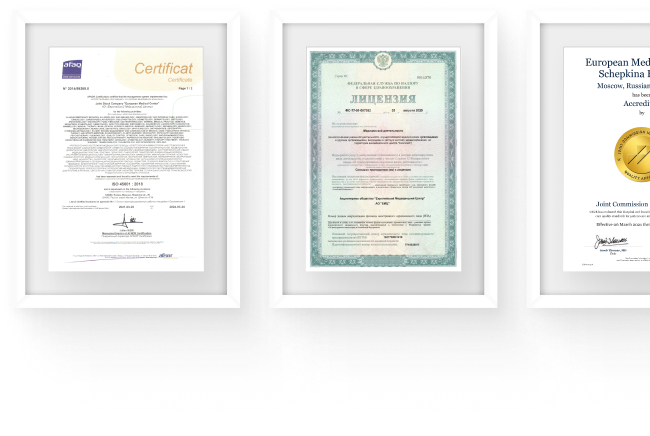
The first and only clinic in Russia, created in the image of the world's leading clinics

Get help
Specify your contacts and we will contact you to clarify the details.
Doctors

Danilov Dmirty
Ph.D. of Medical Sciences
-

Butabaev Rustam
-

Elina Godzhello
Professor, Doctor of Medicine
-

Kim Denis
-

Filippov Mikhail
Ph.D. of Medical Sciences
-

Logvinova Marina
-
Danilov Dmirty
Ph.D. of Medical Sciences
- More than 10 years of experience in emergency endoscopy: stopping gastrointestinal bleeding, removing foreign bodies from the gastrointestinal tract and bronchi
- Proficient in confocal laser endomicroscopy and capsule endoscopy
- He graduated from the Russian National Research Medical University named after N.I. Pirogov, completed his internship and residency in the specialty "Endoscopist"
Total experience
13 years
Experience in EMC
since 2017