The Heart and Vascular Clinic of the European Medical Center specializes in the treatment of the entire spectrum of congenital and acquired heart defects in children and adults.
The clinic's specialists carry out a comprehensive examination, clinical observation, therapeutic correction, preparation for surgical treatment, as well as endovascular treatment of such defects as:
-
atrial septal defect (ATRI)
-
ventricular septal defect (IVD)
-
open ductus arteriosus
-
aortic coarctation
-
pulmonary artery stenosis
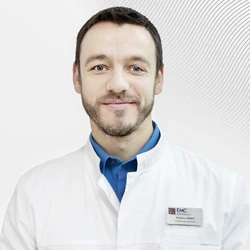
The operations are performed by one of the leading specialists in endovascular surgery and treatment of congenital heart defects in the Russian Federation, Professor Manolis Pursanov.
Congenital heart defects are often combined with other diseases. In a multidisciplinary clinic, it is possible to monitor patients after surgical treatment of CHD with the involvement of specialists of any profile (pediatricians and general practitioners, as well as dentists, ENT doctors, ophthalmologists, rehabilitologists, nephrologists, gastroenterologists, etc.).
What is congenital heart disease (CHD)?
Congenital heart disease (CHD) is a defect in the structure of the heart that develops during fetal development. The prevalence of the disease ranges from 8 to 10 children per 1,000 births.

There are several dozen types of congenital heart defects, from simple and not dangerous to health to complex, associated with significant defects and leading to serious consequences. Most congenital anomalies are diagnosed and treated in early childhood, but some malformations first manifest themselves in adolescents and adults.
Types of heart defects
The most common ones include:
An interventricular septal defect is an opening in the septum separating the right and left ventricles. As a result, blood from the left ventricle flows back into the right ventricle, which leads to a malfunction of the heart and the entire circulatory system. One of the most common types of congenital diseases of this profile.
Atrial septal defect is an opening in the septum between the atria, the presence of which leads to abnormal flow from the left atrium to the right and stagnation in the lungs. It is a common type of the disease, more common in women. Atrial septal defects of small or medium size are often asymptomatic in childhood. Some do not require intervention or treatment.
The open ductus arteriosus is a communication between the pulmonary artery and the aorta, which normally closes shortly after the birth of a child. An open ductus arteriosus is common in premature infants. The presence of a small duct is usually asymptomatic; with larger disorders, signs of heart failure may develop.
Open Atrioventricular Canal (AVC) is a group of malformations that include several anomalies, most often a defect of the atrial septal and interventricular septal, abnormal formation of the mitral and/or tricuspid valves, and their combination.
Pulmonary artery stenosis causes narrowing of the pulmonary artery, a large blood vessel that drains blood from the right ventricle to the lungs. The constriction causes the myocardium to pump blood intensively, which leads to an increase in the size of the organ and an increase in pressure in the right half of the heart. In mild cases, symptoms may be absent.
Aortic stenosis — in this defect, the aortic valve between the left ventricle and the aorta has not formed properly and is narrowed, which makes it difficult for the heart muscle to work.
Aortic coarctation is a narrowing of the aortic lumen, as a result of which blood flow to the lower body is disrupted and pressure increases above the site of narrowing. There are usually no symptoms at birth, but they can develop as early as the first week after birth. With pronounced narrowing, there may be signs of heart failure or high blood pressure.
Transposition of the main vessels is a congenital disease in which the two main arteries that drain blood from the heart — the main pulmonary artery and the aorta — are swapped or "transposed".
Fallot's Tetrad:This is a complex defect, manifested by four defects, including a defect of the interventricular septum; narrowing of the mouth of the pulmonary trunk, which partially blocks the flow of blood from the right heart to the lungs; hypertrophy of the right ventricle and displacement of the aorta, which is located directly above the defect of the interventricular septum.
Surgical treatment is necessary for most malformations.
Rare types include valve defects such as Ebstein's anomaly, coronary artery anomalies, and others.
What causes congenital heart defects?
Many heart diseases in children are caused genetically.
In particular, the risks of developing the disease are increased by:
-
chromosomal abnormalities such as Down syndrome, trisomy 18 and trisomy 13, as well as Turner syndrome
-
microdeletion or microduplication syndromes, such as Giorgi's syndrome
-
defects in one gene
-
mixed and as yet unknown factors
If there are cases of congenital diseases in the family, future parents are advised to undergo a medical and genetic examination before planning pregnancy.
What are the symptoms of congenital heart disease?
The symptoms of the disease in infants and children include:
-
cyanosis (bluish tint of skin, nails and lips)
-
respiratory disorders
-
lack of appetite, sluggish sucking with frequent interruptions
-
poor weight gain
-
recurrent lung infections
-
lower ability to exercise or play active games compared to other children
-
increased blood pressure
How are congenital heart defects diagnosed?
In most cases, abnormalities in the development of organs are detected even before the birth of a child during an ultrasound examination of the fetus. Some types of complex defects appear soon after birth. Less serious defects can be detected at an older age.
What tests are performed for congenital heart defects?
Depending on the symptoms of CHD in a child or the presence of a heart murmur, the following types of studies are prescribed:
If a child has been diagnosed with a chromosomal or other genetic abnormality, genetic counseling will be useful to determine the risk of developing heart defects when planning the next pregnancy.
How are congenital heart defects treated?
Treatment depends on the specific type of disease and its severity. Some diagnosed disorders do not require treatment. Others can be treated with endovascular procedures or drug surgery. If it is necessary to correct the manifestations of CHD (cyanotic seizures, heart failure, pulmonary hypertension, and others), then medications may be prescribed as supportive therapy.
When using endovascular surgery, the surgeon's work is performed without the use of artificial blood circulation and chest opening. This significantly reduces the duration of the intervention and greatly reduces surgical trauma and its consequences. The type of anesthesia is also changing: endovascular treatment uses less deep anesthesia than with open interventions. The surgeon works using a digital X-ray machine, monitoring his actions and the result of manipulation through the use of a contrast agent that allows visualizing the heart and blood vessels on the screen. Special echocardiography techniques are also used. All this allows you to evaluate the effectiveness and outcome of the treatment immediately after the manipulation.
During endovascular surgery, closure of defects is performed using occluders or coils, which are delivered to the defect site via intravascular catheters.
What are the long-term prospects for congenital heart defects?
Thanks to the development of early diagnosis and surgical treatment methods, the prognosis for many congenital heart defects is becoming more and more positive, even with the most difficult problems.




.webp)






.webp)

.webp)